From basic brews to fourth wave thinking
Exploring coach learning through coffee
The back story…or the basic brew
Originally inspired by Anna Stodter and Chris Cushion’s 2017 paper, “What works in coach learning, how, and for whom?”. Here, we explore extensions to this study which aimed to understand how football coaches learn, what influences this learning, and how this shapes coaching knowledge and practice.
Key findings from this work noted that coaches’ conceptions of knowledge were influenced by formal coach education, in interaction with wider informal experiences (e.g., prior playing, observation, mentoring) and cycles of application in practice. Learning was limited by mismatches between what formal courses intended to get across and what participants perceived or already did, knew, believed and valued. A summary of this work can be found here – A thinking tool to improve learningWhy do we pick up certain things and ditch the rest?
From this research, the ‘learning filter process’ was constructed. A theory, grounded in data from coaches, explained how learning happened:
- Existing biography (beliefs, knowledge, practice) filtered new ideas.
- Concepts that ‘fit’ were accepted; those that didn’t were rejected or adapted.
- A reflective feedback loop tested and integrated ideas that ‘worked’ in practice.
- Context ultimately overruled individual factors in shaping learning.
The second stage: coach learning and coffee filters
Anna Stodter re-imagined the original ‘learning filter process’ using coffee and how it is brewed as an analogy for how coaches learn. The coffee filter represents a coach’s biography, all their past experiences, beliefs, values, and practices. When a new idea (a shared concept, which could be thought of as coffee grounds broken down small enough to be consumed) enters the filter, it can take three routes:
- Match and it’s passes straight through unfiltered because it aligns with existing beliefs (“that makes sense, I already do that, I’ll do it more”).
- Mismatch and it’s filtered out/rejected as it contradicts prior knowledge or experience (“that won’t work here”).
- Fit and it permeates through partially, leading to experimentation and adaptation (“let’s give that a try, but tweak it for my participants/context”).
A Coffee Break Consideration
Although…there is perhaps another route, relating to the stuff coaches don’t even notice. Based on biography guiding coaches’ noticing, some ideas might be overlooked and not even enter the initial filter process of accept, reject, or adapt. Might these same ideas be noticed at another time, when biography (and the filter) has changed (you tell me)?
Let get back to that second stage…
For a concept to ‘percolate’ into practice (by drinking from the coffee cup in this metaphor), it needs to be tasted i.e., tried out and adjusted or adapted further (e.g., ‘add milk or sugar’) based on contextual factors such as situational constraints, environment, or culture. Through individual and contextual level filters, and cycles of experimentation, a double-loop learning process is created: reflection and adaptation continually reshape the coach’s knowledge and practice (their biography), which in turn influences how they filter future learning.
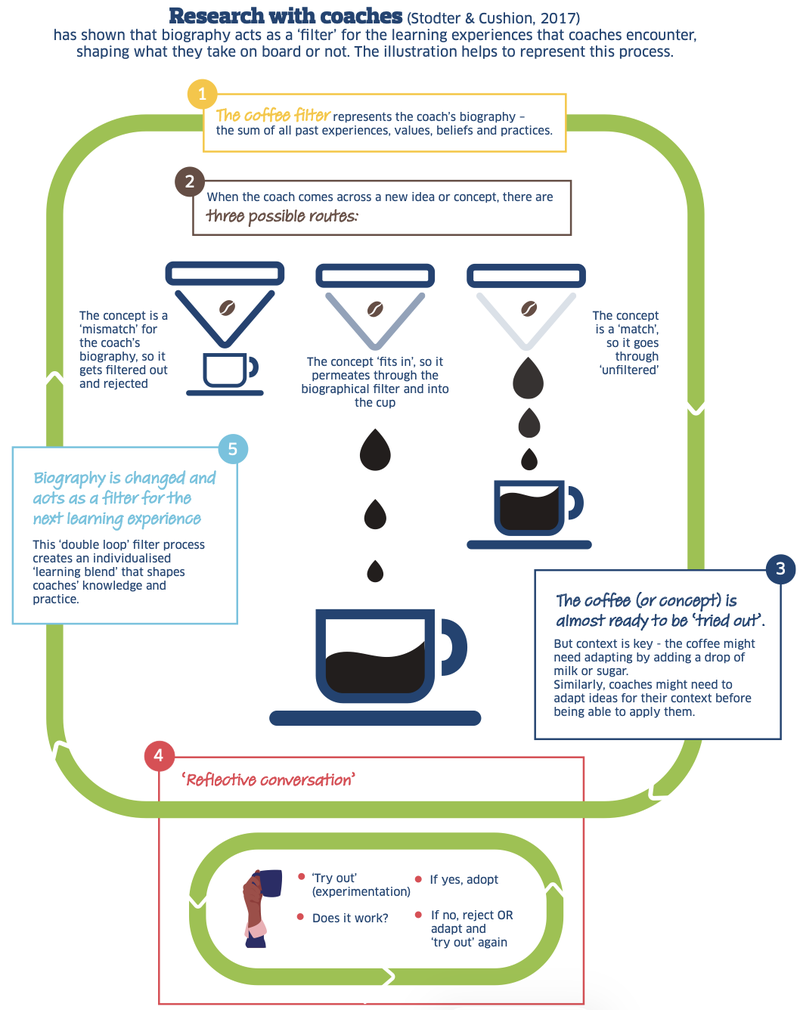
Stodter (2022) Ten things I’ve learned from ten years of coach learning research
The coffee filter metaphor is essentially the visual and experiential embodiment of theory explaining processes of learning in practice, and it can help us to reflect on wider professional learning as well as the filters or conditions that can influence this.
Third wave thinking: coffee filters, cultural waves and coach learning maturity
This is where it gets exciting (well for me anyway). If we see the coffee filter as representing the learner’s biography (their experiences, values, beliefs, knowledge, and practices) and new ideas as the coffee grounds, passing through this filter, where some ideas are:
- Accepted (they fit the learner’s worldview),
- Rejected (they clash with it), or
- Adapted (they are modified to fit the learner’s needs and context).
The resulting brew is the learner’s knowledge and practice, flavoured by what has passed through the filter and the context in which it is tested. Over time, the coach as a professional, through their filtering process and adaption (the added milk and/or sugar) evolves in a lifelong learning process.
We might extend the metaphor to draw parallels with the ‘waves’ of coffee culture (this is a cool read in it own right) seen over the past few decades. Each wave reflects a shift from functional, mass-produced convenience to craft, ethics, and sustainability. Moving from instant coffee to artisanal café culture. In our context, each wave represents a stage of coaching and learning maturity, showing how filters, ideas, and cultures might evolve over time.
The four waves: coffee and coach learning evolution
In essence, learning is not just about the quality of what flows through the filter (the type of beans used, providing ideas or content), but also how the filter itself (the learner’s biography) changes over time, and the impact on practice outcomes across waves of experience, reflection, and cultural evolution. The table below starts to illustrate what these four waves of coach learning may look like, from off the shelf instant learning (instant coffee) to the more artisan nuanced experience (coffee with depth, texture, aroma).
| Wave | Coffee Culture | Coach Learning Focus | Filter Characteristics | Learning & Practice Outcomes |
| 1. First Wave – Commodity Coffee | Instant, accessible, standardised | Instructional – drills, methods, compliance | Rigid filter, driven by habit and tradition | Quick results, shallow reflection, inflexible outcomes |
| 2. Second Wave – Café Culture | Experience, identity, connection | Reflective – curiosity, learner focus, dialogue | Loosening filter, growing awareness of context | Emerging reflection, relational learning, experimentation |
| 3. Third Wave – Craft Coffee | Skill, precision, origin | Adaptive – inquiry, evidence, craft development | Tuned filter, deliberate reflection, curiosity for ‘why’ | Nuanced practice, learning through inquiry and testing |
| 4. Fourth Wave – Sustainable Coffee | Ethics, transparency, shared value | Transformative – culture, systems, ethics | Changeable filters, reflexive, open to challenge | Collective reflection, sustainable lifelong learning cultures |
Coffee in context: situated coach learning
We know that coaches do not brew knowledge and practice in isolation, and these waves reflect the broader learning ecosystem. Their unique learning blend exists within systems including teams, clubs, governing bodies, development and performance cultures. Some of these are churning out instant coffee, while others are building specialty roastery tasting rooms.
Encouraging coaches to consider what wave their club/organisation is operating in could help them understand the constraints or opportunities of their context. A coach’s ability to accept, reject, or adapt new ideas is heavily influenced by their organisational context. Even if an idea ‘fits’ the coach’s biography, it might not fit the environment they work in (e.g., role expectations, traditions, resources, values, leadership). Likewise, a supportive culture can open up filters, making adaptation and experimentation easier.
Filter maintenance/upgrades: coach learning reflexivity
If waves don’t advance, then maybe the filter needs maintenance or upgrading e.g. cleaning the filter (check and challenge assumptions and biases), replacing the filter (purposefully changing biography, beliefs, practices), adjusting the brew (altering the context or improving learning conditions with time, support, or feedback). These processes emphasise the need for reflexivity, continuous professional development, and a lifelong learning approach.
To operationalise the metaphor more practically, we can build in the Scandinavian concept of Fika. This is a cultural ritual that involves purposeful pause, social connection, and reflective conversation. Fika represents the reflective space and momentum needed to move between waves, a deliberate moment to notice how our filters are working and whether they need attention.
These ideas can give coaches a useful way to prompt reflection, asking ‘which wave am I on?’
- What kind of coffee (learning) am I brewing right now?
- What does my filter let through too easily or block too soon?
- Which wave best describes my current learning environment?
- What would need to change in my context to help me move to other waves?
- What kind of ideas am I seeking out, are they wave 1, 2, 3, or 4?
- What wave is my club or organisation operating in and how does that shape the way I learn, experiment, or change my practice?
And, of equal importance – How can I help others maintain or evolve their filters?
Summary
The ‘waves of coffee culture’ can offer a rich additional dimension to the coffee filter metaphor by helping to illuminate the stage or maturity of your coach development and lifelong learning. It offers a journey map for understanding how lifelong learning could evolve, how their filter operates, how contexts shape knowledge and practice, and how they might progress toward more adaptive, ethical, and sustainable practice.
Learning, much like coffee, is enhanced when it’s shared, tasted, questioned, and experienced together. If these ideas ‘fit’ with you, and you’d like to continue the conversation over a cup of freshly brewed coffee, on 10th July 2026 we’re hosting a Filter and Brew Collaborative Coach Development Workshop with the Centre for Sport Coaching at Leeds Beckett University.
We’re aiming to curate an open, conversation‑rich session blending reflective practice with the practicalities of coffee tasting. It’s an opportunity to connect, explore ideas with others, and experience how metaphors could become methods when we put them into practice. Be brave – reach out directly either contact myself kurt@bemorelnd.co.uk or Anna Stodter at A.Stodter@leedsbeckett.ac.uk, and keep filtering, brewing, and learning together.
Based on the paper by: Anna Stodter & Christopher J. Cushion (2017): What works in coach learning, how, and for whom? A grounded process of soccer coaches’ professional learning, Qualitative Research in Sport, Exercise and Health, DOI: 10.1080/2159676X.2017.1283358